Annual Reports
Oscar Health, Inc.'s annual reports contain management's most considered account of the business. These are the sections, passages and visual pages worth opening in the originals preserved in Sources.
Oscar Health, Inc. — FY2025 Annual Report (Form 10-K) — FY2025 (year ended December 31, 2025)
The latest 10-K: 2.0m members, $11.7bn revenue, a $443m net loss, MLR 81.7%→87.4%, and a $2.53bn net risk adjustment payable. · Open the full document →
Item 1. Business — Our Business and Our Offerings — p. 7 · Read the full section →
Management's definition of a now single-line business: ACA individual plans, with 93% of 2025 premium paid directly by CMS.
What Oscar sells after exiting Medicare Advantage and Small Group, and the three 2025 ICHRA acquisitions.
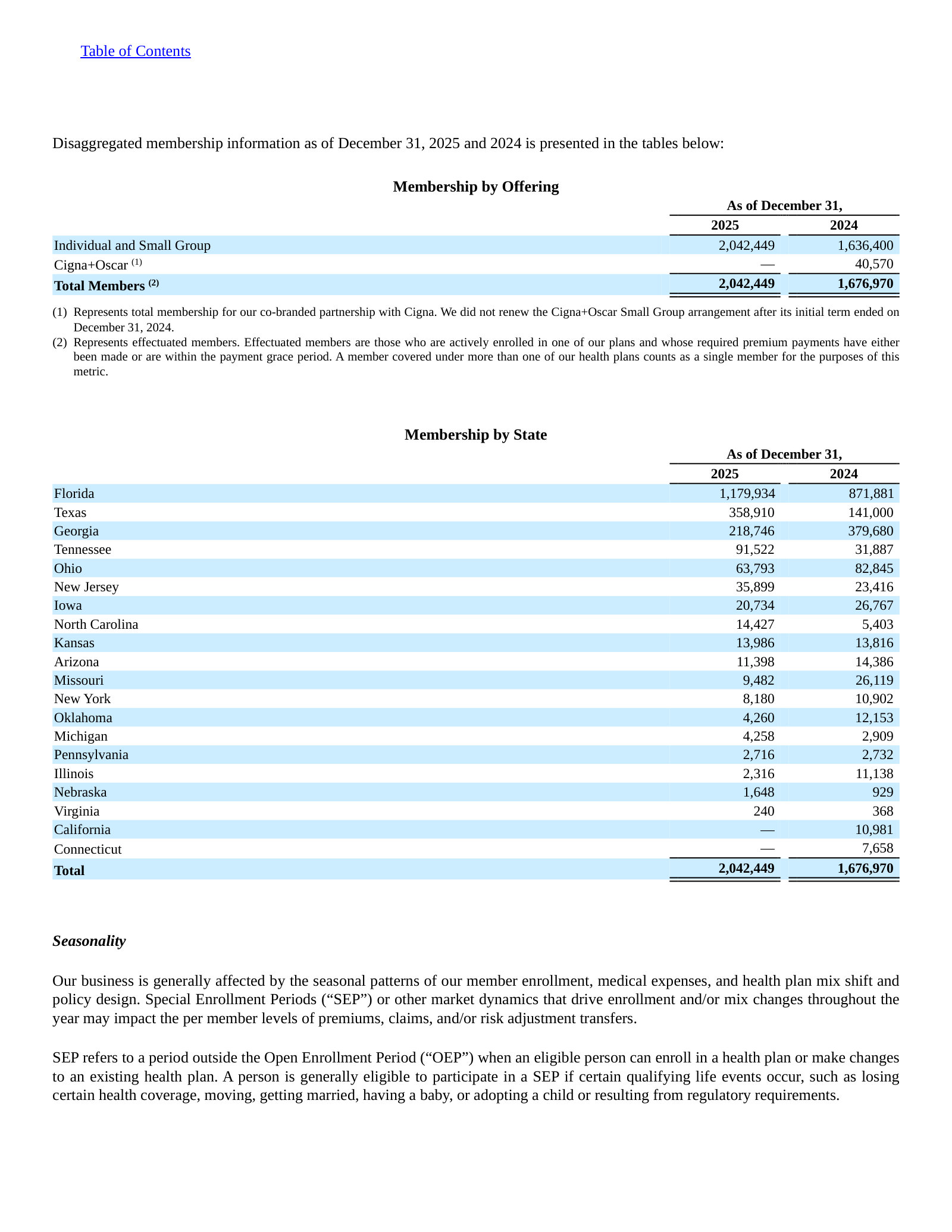
Oscar is a leading healthcare technology company built around a full stack technology platform and a relentless focus on member experience. We offer health plans through the ACA serving individuals, families, and employees. We have been challenging the status quo in the healthcare system since our founding in 2012 and are dedicated to making a healthier life accessible and affordable for all. Our technology drives superior experiences, deep engagement, and high-value clinical care, earning us the trust of approximately 2.0 million effectuated members, as of December 31, 2025. […] In 2025, we also acquired early-stage businesses with capabilities to help us power Individual Coverage Health Reimbursement Arrangements (“ICHRA”) and further diversify the Company. These assets include Lucie, Inc. (f/k/a INSXCloud, Inc.), a direct enrollment technology platform; IHC Specialty Benefits, Inc., an individual market brokerage; and Healthinsurance.org, LLC, a consumer education website. […] Oscar's health plans are offered in the individual market. The individual market primarily consists of policies purchased by individuals and families through health insurance marketplaces, established by the ACA and operated by the federal government, as well as other marketplaces operated by individual states (collectively, “Health Insurance Marketplaces”). Individuals and families may also purchase policies in the individual market off-exchange. Employees whose employers have chosen to offer an ICHRA are also able to purchase Oscar’s health plans.
p. 7 · Read in context →
Item 1. Business — Our Strategic Focus — p. 14 · Read the full section →
The forward bet in management's words: ICHRA displacing employer group coverage, which is what the 2025 acquisitions were bought to serve.
The stated long-term vision and the ICHRA thesis the 2025 acquisitions were made to support.
Our long-term vision is to build the consumer marketplace of the future and lead the individual market. We built our strategy around several core trends in healthcare, including rising consumer and employer healthcare costs, consumerization, digitization, and the shift towards personalization. Over time, we have been observing the overall healthcare system move towards these trends, which not only validates our strategy, but provides us with a first mover advantage. […] We continue to believe ICHRA will disrupt employer group coverage and expand individual insurance beyond the traditional ACA market. Our goal is to position Oscar as the preferred carrier for employees enrolling in health insurance through an ICHRA program. […] The businesses that we purchased in 2025, including Lucie, Inc. and IHC Specialty Benefits, Inc., provide important building blocks to support our ICHRA strategy and long-term vision to build the leading consumer health marketplace.
p. 14 · Read in context →
Item 1A. Risk Factors — Our success and ability to grow our business depend in part on retaining and expanding our member base. […] — p. 33 · Read the full section →
The largest open question for OSCR: enhanced ACA subsidies lapsed 31 Dec 2025, and both renewal and non-renewal carry costs.
eAPTC expiry, the OBBBA eligibility cuts, and why a mid-2026 renewal would itself be disruptive.
The OBBBA enacted several provisions that may impact the number of enrollees in Health Insurance Marketplaces and, by extension, the size of our member population. These include ending the APTCs for individuals who enroll in plans via the SEP with income below 150% of the FPL, prohibiting automatic re-enrollment for tax year 2028, and eliminating APTC eligibility for some formerly covered individuals (such as refugees and other immigrant populations). While we expect these provisions to result in a reduction in the number of enrolled individuals in the Health Insurance Marketplace, we cannot predict with certainty the magnitude of the impact on our membership or our business. […] Even though the eAPTCs expired at the end of 2025, it is possible that they could be renewed, but the timing of such a decision, and the manner in which the eAPTCs could be renewed, is uncertain and could occur in 2026, which could cause potential disruption and uncertainty for the 2026 OEP. […] If the eAPTCs are renewed, it is possible that a SEP would be initiated which could alter member mix and enrollment levels (including by allowing individuals who enrolled with us during open enrollment to switch to a competitor’s plan), as well as shift consumer behavior.
p. 37 · Read in context →
Item 1A. Risk Factors — Failure to accurately estimate our incurred medical expenses or overall market morbidity […] — p. 39 · Read the full section →
The mechanism behind the FY2025 loss: premiums are set a year ahead on a forecast of market morbidity, and 2025 proved it wrong.
Pricing is set in advance on projected market morbidity — the assumption the year turned on.
We set our premiums in advance of each policy year based on competitive factors in each market in which we participate as well as projections of our future expenses and of the future morbidity of the Health Insurance Marketplace. As a result, the profitability of our insurance business depends, to a significant degree, on our ability to accurately estimate and effectively manage our medical expenses and administrative costs, as well as accurately estimate the future morbidity of the Health Insurance Marketplaces and estimate our risk adjustment transfer.
p. 39 · Read in context →
From the risk adjustment risk factor: the 2025 morbidity surprise, and the statutory capital it can consume.
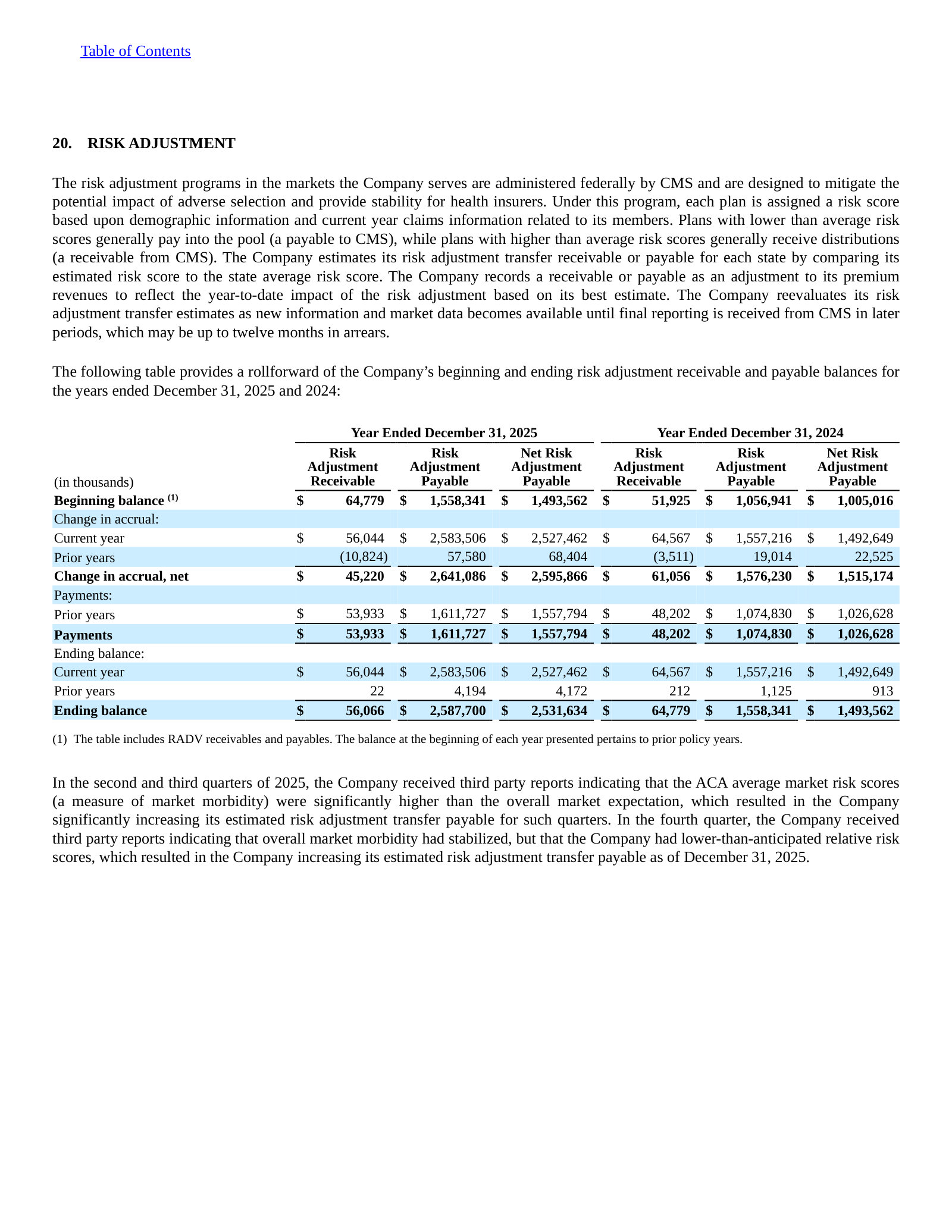
For example, in the second and third quarters of 2025, the Company received third party reports indicating that the ACA average market risk scores (a measure of market morbidity) were significantly higher than the overall market expectation, which resulted in the Company significantly increasing its estimated risk adjustment transfer payable for such quarters. In the fourth quarter, the Company received third party reports indicating that overall market morbidity had stabilized, but that the Company had lower-than-anticipated relative risk scores, which resulted in the Company increasing its estimated risk adjustment transfer payable as of December 31, 2025. […] Furthermore, a significant change in our risk adjustment transfer estimates could require us to contribute additional capital to our Health Insurance Subsidiaries to meet statutory capital requirements. We may not be able to fund the increased capital contribution requirements with our available cash resources on a timely basis, or at all and may need to incur indebtedness or issue additional capital stock.
p. 43 · Read in context →
Item 7. MD&A — Recent Developments, Trends and Other Key Factors Impacting Performance — p. 99 · Read the full section →
Management's list of what moved 2025 and what is unresolved for 2026, starting with the subsidy that built the membership base.
The eAPTCs that grew the marketplace since 2021 expired at the end of 2025.
The enhanced Advanced Premium Tax Credits (“eAPTCs”) that were previously in place since 2021 contributed to increases in the population of the health insurance marketplaces established by the ACA and operated by the federal government, as well as other marketplaces operated by individual states (collectively, “Health Insurance Marketplaces”), as well as increases in our membership. […] These eAPTCs expired at the end of 2025 and if they are not renewed in 2026, coverage could become unaffordable to some individuals and thereby reduce overall participation in the Health Insurance Marketplaces
p. 99 · Read in context →
Item 7. MD&A — Critical Accounting Policies and Estimates: Benefits Payable — p. 106 · Read the full section →
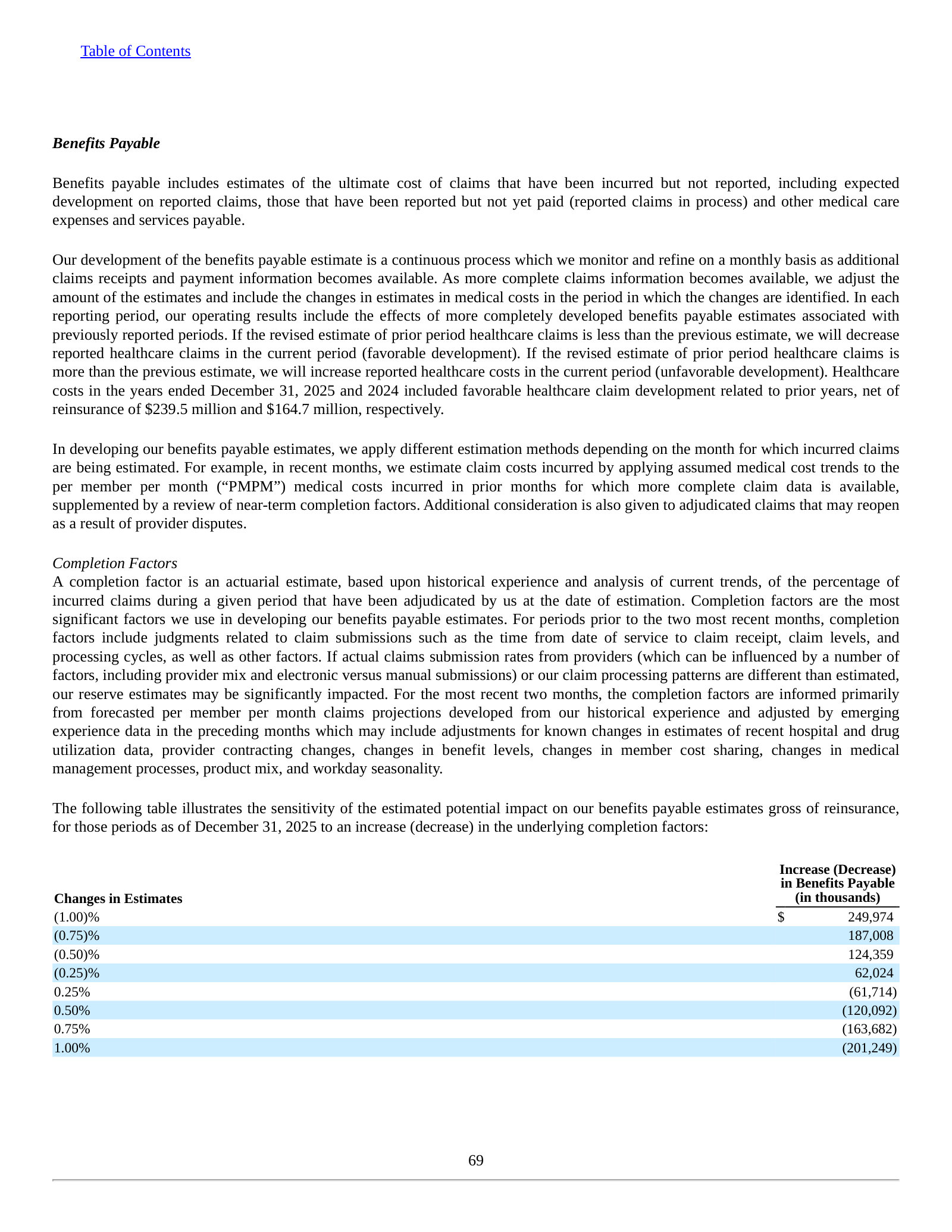
The accounting that sets reported earnings for an insurer: completion factors drive the IBNR reserve, and a 0.25% error moves it ~$62m.
How the reserve is built and why completion factors are the estimate that matters.
Our development of the benefits payable estimate is a continuous process which we monitor and refine on a monthly basis as additional claims receipts and payment information becomes available. As more complete claims information becomes available, we adjust the amount of the estimates and include the changes in estimates in medical costs in the period in which the changes are identified. […] A completion factor is an actuarial estimate, based upon historical experience and analysis of current trends, of the percentage of incurred claims during a given period that have been adjudicated by us at the date of estimation. Completion factors are the most significant factors we use in developing our benefits payable estimates. […] If actual claims submission rates from providers (which can be influenced by a number of factors, including provider mix and electronic versus manual submissions) or our claim processing patterns are different than estimated, our reserve estimates may be significantly impacted.
p. 106 · Read in context →
Item 7. MD&A — Results of Operations — p. 111 · Read the full section →
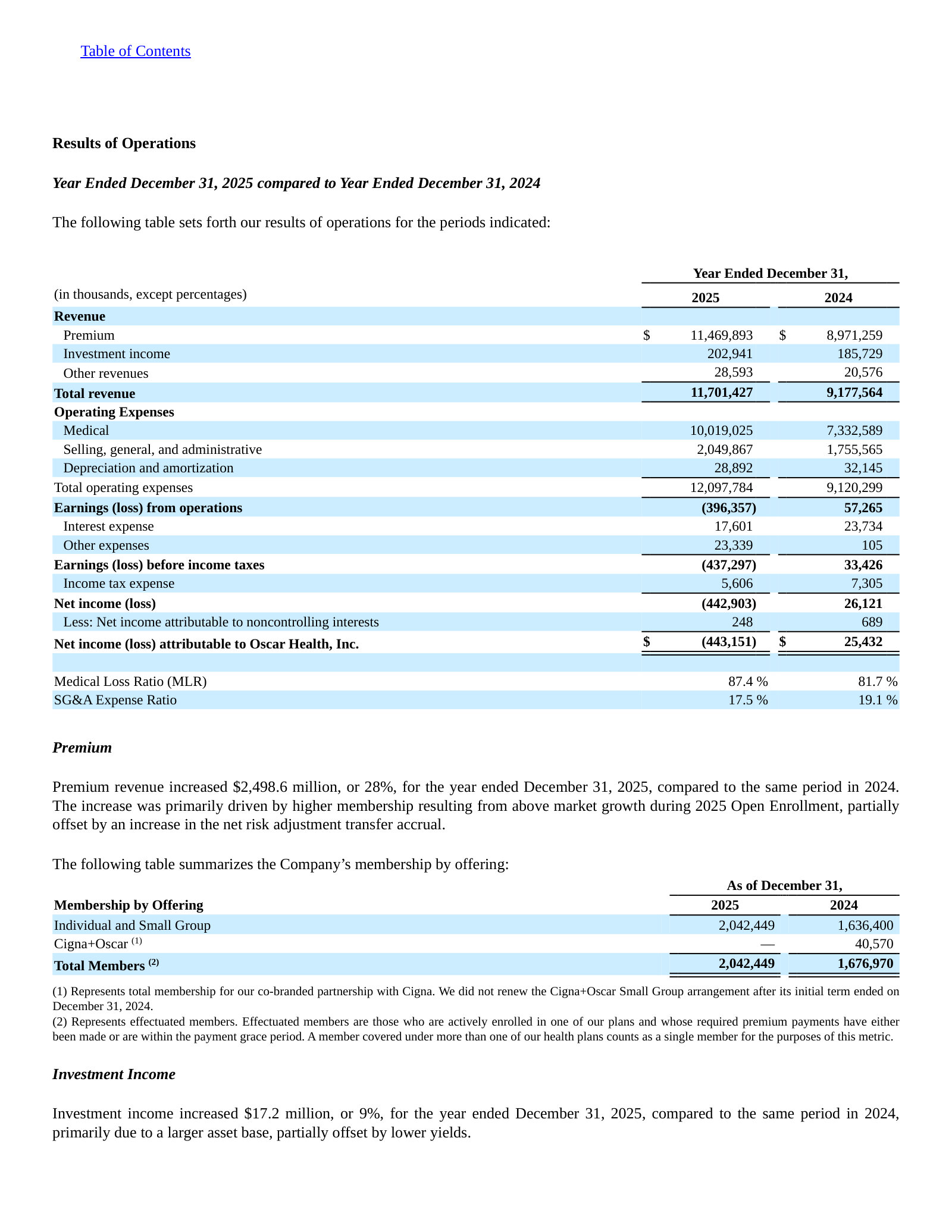
The year in one page: total revenue +27% to $11.7bn, medical expense +37%, and $57m of operating profit becoming a $396m operating loss.
Management's attribution of the 5.7-point MLR increase and the offsetting SG&A leverage.
Medical expenses increased $2,686.4 million, or 37%, for the year ended December 31, 2025, compared to the year ended December 31, 2024, primarily due to increased membership and medical cost trend. MLR increased 5.7% year over year for the year ended December 31, 2025, primarily driven by an increase in average market morbidity that resulted in an increase in the net risk adjustment transfer accrual, as well as higher utilization that was not fully offset by risk adjustment. […] The SG&A Expense Ratio decreased 160 basis points year over year for the year ended December 31, 2025, primarily due to greater fixed cost leverage, lower exchange fee rates, and disciplined cost management, partially offset by the impact of higher risk adjustment as a percentage of premium.
p. 113 · Read in context →
Note 20. Risk Adjustment — p. 177 · Read the full section →
The rollforward that sizes the problem: the current-year risk adjustment payable rose from $1.56bn to $2.58bn in a single year.
Oscar Health, Inc. — FY2021 Annual Report (Form 10-K) — FY2021 (year ended December 31, 2021)
The first post-IPO full-year 10-K, and the clearest picture of what Oscar has since dismantled: three insurance markets and a SaaS ambition. · Open the full document →
Item 1. Business — Our Offerings — p. 7 · Read the full section →
Read against FY2025: three insurance markets and named +Oscar partners — two lines and every partner named here are now gone.
The 2021 three-market model and the +Oscar platform launch, including the Cigna and Health First arrangements.
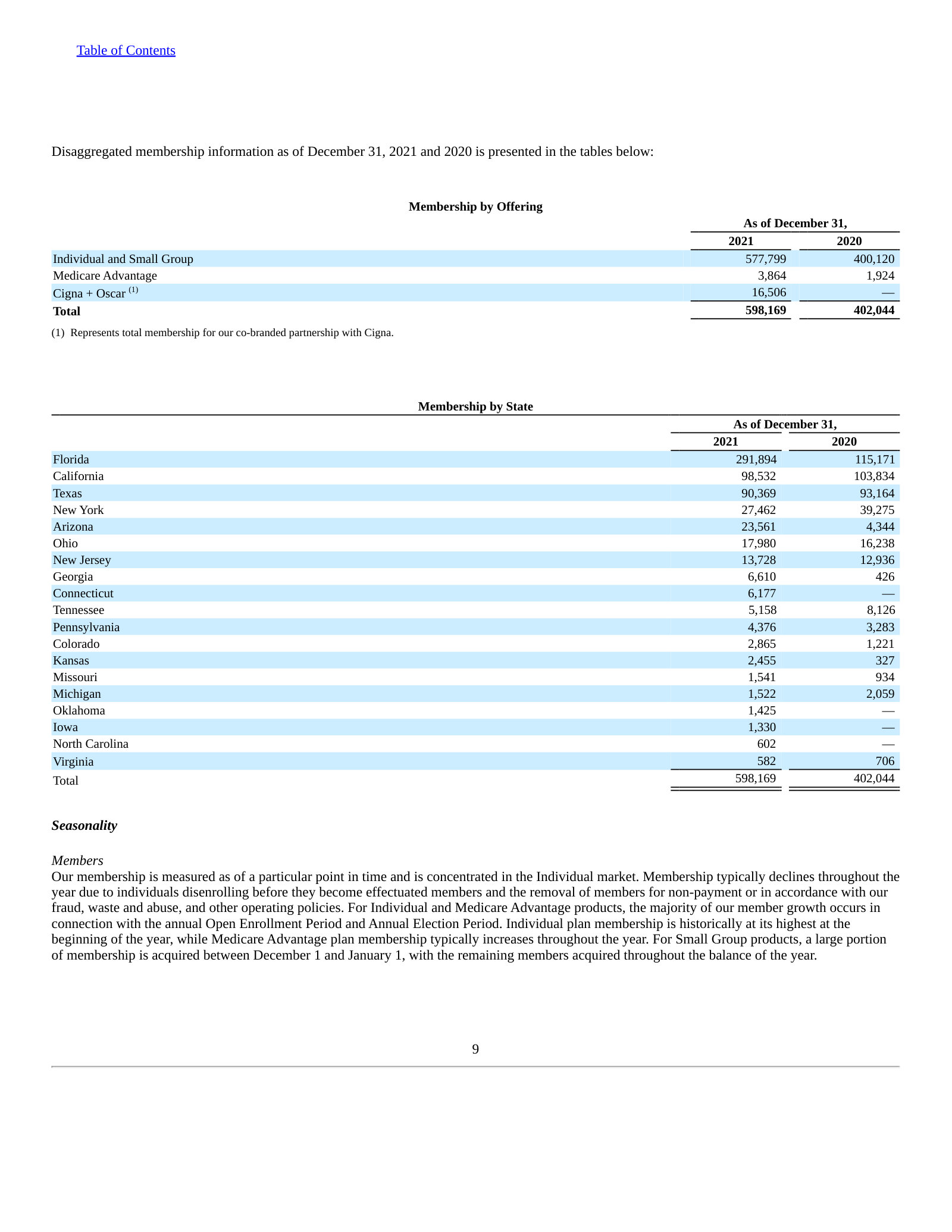
In April 2021, we launched +Oscar, our tech-driven platform designed to help provider and payor clients drive improved efficiency, growth and superior engagement with their members and patients. Through +Oscar, we are monetizing our technology platform by offering business processes as a service to our clients, including Cigna + Oscar and Health First Health Plans. Our +Oscar deals generate fee-based compensation and can include risk-sharing components. We are also pursuing opportunities to offer our +Oscar platform as a software-as-a-service (“SaaS”) to enable future growth in this business. […] Today, we offer health plans in three insurance markets: Individual, Small Group, and Medicare Advantage across 607 counties and 22 states.
p. 7 · Read in context →
Item 1. Business — Our Growth Opportunities: Monetize our platform — p. 11 · Read the full section →
The platform-monetization case as originally put — risk-sharing, fees and SaaS — which FY2025 has narrowed to one product.
The 2021 pitch for selling the technology stack into 'multi-billion dollar industries'.
We have made significant investments to build a unique full stack technology platform that enables innovation in the global health care system. As a result, we believe we are well-positioned to monetize our platform through risk-sharing arrangements (where we take risk for provider claims on behalf of our members), through fee-based service arrangements (where we charge a fee per member or other fee structure) and through the development of a SaaS offering. […] Our platform today also has the ability to deliver solutions that represent multi-billion dollar industries, such as benefits management, claims processing, virtual care, and health care data and analytics. By leveraging our technology in areas such as machine learning, predictive analytics, and multimodal communication, we have built technology that is both member-first and helps lower costs. We believe that we have the ability to power these adjacent industries with our member engagement engine and full stack technology platform.
p. 11 · Read in context →
More annual reports
Oscar Health, Inc. — FY2024 Annual Report (Form 10-K) — FY2024 (year ended December 31, 2024) · 182 pages · The one profitable year: $25.4m of net income on an 81.7% MLR, filed weeks after the Cigna+Oscar Small Group exit took effect. · Open →
Oscar Health, Inc. — FY2023 Annual Report (Form 10-K) — FY2023 (year ended December 31, 2023) · 129 pages · The reset year: the exit from Medicare Advantage for plan year 2024 is documented here, the first 10-K with Mark Bertolini as CEO. · Open →
Oscar Health, Inc. — FY2022 Annual Report (Form 10-K) — FY2022 (year ended December 31, 2022) · 124 pages · The peak-loss year — $606.3m net loss — and the last 10-K written with Medicare Advantage, Small Group and +Oscar all still in the plan. · Open →